
Merced County Court Records After Arrest
The arrest to court path has several distinct records. The Merced County Sheriff's roster is the custody side. It can show booking number, booking date, bail and bond fields, court date, court room, and charge rows. The court record begins when the prosecution files charges with the Superior Court. California Courts explains that a criminal case usually starts when the prosecution files charges in court, often through a complaint.
The Merced County District Attorney is the local charging office. The county identifies Nicole Silveira as District Attorney, with the main DA office in Merced and a Los Banos office. The DA reviews law-enforcement reports after arrest and may file, decline, add, reduce, amend, or dismiss charges. That is why a booking charge in Merced County jail inmate records may not match the final court charge list. Booking photos are a separate records topic and are handled on the Merced County jail mugshots page.
The DA source page is available from the Merced County District Attorney office listing.
The DA page is relevant because filed charges are prosecution decisions, while jail custody records are maintained by the sheriff.
Merced Court Records Are Limited Online
Merced Superior Court has a Tyler public portal, including Smart Search and hearing search modules, but the court's own online records page states that criminal case information is not available online. That local caveat controls the court-records-after-arrest workflow. A user may see portal tools, yet still need the Clerk's Office or the court record request form for criminal case information.
The Merced Superior Court case records search notice is the key source for this limitation.
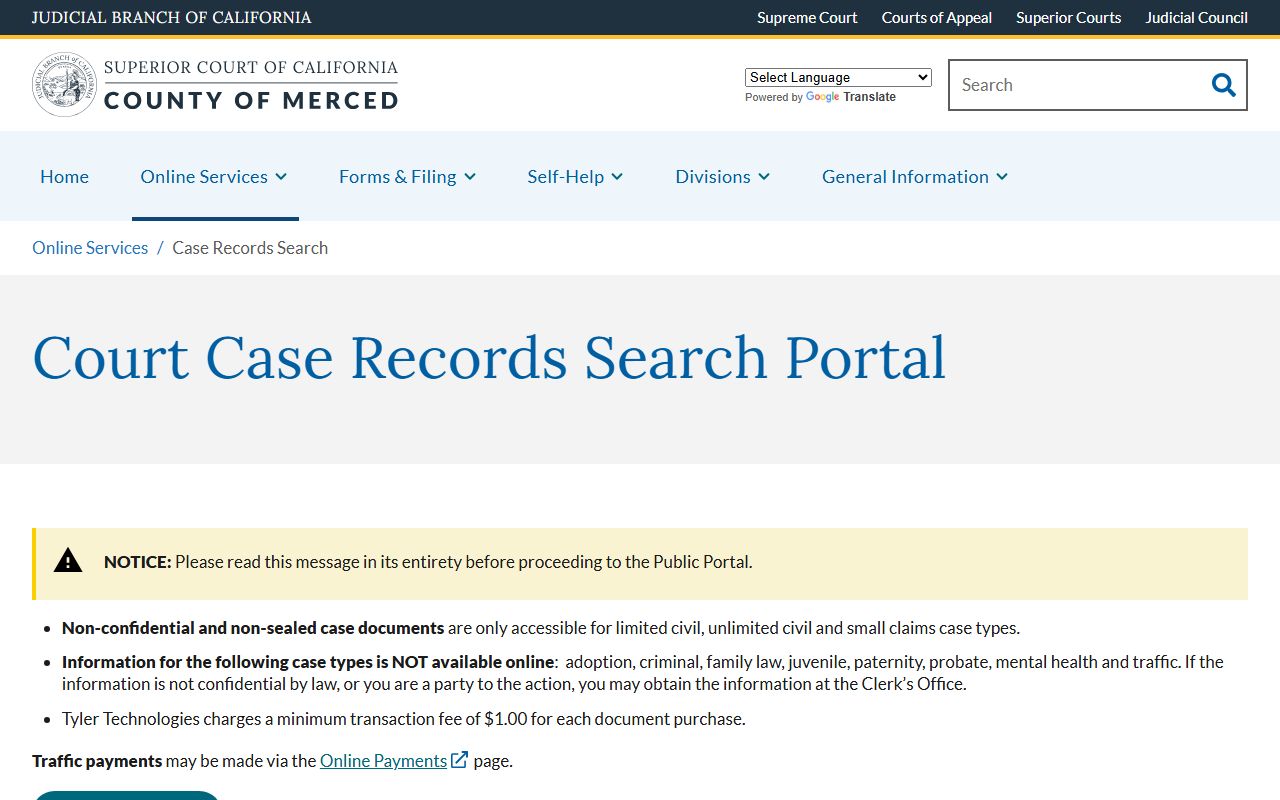
The notice prevents a common mistake: treating the Tyler portal as a complete online criminal case database for Merced County.
Merced Court Smart Search Fields
The court's Tyler public portal Smart Search interface was inspected as a portal tool, even though criminal case information is not online under the court's public notice. Treat these fields as portal navigation fields, not as a promise that every criminal record after arrest will appear for free online.
| Search Area | Field or Control | Use |
|---|---|---|
| Smart Search | Record number or name | General portal search when a case number or party name is known. |
| Advanced filters | Case category and case type | Can narrow portal results, but criminal availability is limited by court policy. |
| Search Hearings | Date range | Used to look for hearings rather than full case files. |
| Search Hearings | Location or department | May help locate a courtroom or calendar item. |
| Document purchase | Registration requirement | Research notes registration is required to purchase documents. |
When the portal does not provide the criminal case detail, use the court's request form and criminal division contacts instead of assuming no case exists.
Merced Court Records Request Fees
The court record, search, and copy request form is the practical route for many court records after a jail arrest. The form asks for the requester's name, mailing address, phone, email, case category, name to search, AKAs, date of birth, driver's license, case number if known, violation or charge, violation date, approximate filing dates, and the specific records requested.
| Item | Amount or Rule | Source Detail |
|---|---|---|
| Court employee search over 10 minutes | $15 per search | Government Code 70627(c) cited by the form. |
| Copies | $0.50 per page | Standard copy charge on request form. |
| Certified copies | $40 | Government Code 70626(a)(4) cited by the form. |
| Certified dissolution copy | $15, or $10 for public agency requests | Listed on form, mostly civil family context. |
| Off-site retrieval | $15 | California Rule of Court 10.815 and Government Code 70631 cited by the form. |
| Mailed request | Check or money order plus self-addressed stamped envelope | Required for mailed processing. |
Files pulled for viewing are held 10 days from notification. For local criminal matters, the Ogletree Jr. Courthouse Criminal Division at 2260 N Street in Merced is the main criminal court contact, with the Los Banos Robert M. Falasco Justice Center also handling criminal services.
Charging Documents After Arrest
A charging document is the paper that moves an accusation into court. It is not the same as the jail booking entry. Merced County court records after arrest may involve different document names depending on the stage and seriousness of the case.
| Document | Who Uses It | What It Does |
|---|---|---|
| Complaint | Prosecutor | Common starting document for a California criminal case after prosecutor review. |
| Information | Prosecutor | Felony charging document often used after preliminary-hearing procedures. |
| Indictment | Grand jury process | Formal accusation returned through grand jury procedures, less common in routine local cases. |
A booking charge can be amended, reduced, or replaced after the police report is reviewed. Court records should be checked by case number when possible because names can repeat and charges can be split across more than one case.
Merced Charge Status Records
Charge status describes where an accusation stands in court. It can change at arraignment, after negotiations, after preliminary proceedings, or at sentencing. The status is separate from whether a person is in custody on the sheriff roster.
| Status | Plain Meaning | Records Caution |
|---|---|---|
| Pending | The charge has not reached final disposition. | Do not treat it as a conviction. |
| Amended | The charge language or code was changed. | Compare the latest filing to the booking entry. |
| Reduced | The prosecution or court moved the accusation to a lesser charge. | The original arrest allegation may still appear in some records. |
| Dismissed | The charge was ended without a conviction on that count. | Dismissal does not automatically erase all public records. |
| Convicted | A plea or verdict resulted in guilt on that count. | Sentencing and custody may move to jail, probation, or CDCR. |
Merced Bail After Jail Arrest
Merced County bail records sit between jail custody and court control. The sheriff profile may show Total Bond Amount, Total Bail Amount, Bond Number, Bond Type, and Bond Amount. Those fields can help a family member understand the current custody record, but the court's bail schedule and the judge's orders control the legal setting.
Merced Superior Court posts a 2026 Felony Bail Schedule effective January 1, 2026, and a 2026 Uniform Bail and Penalty Schedule. Research examples show presumptive bail amounts by top state-prison term when no specific amount is listed, including $20,000 for a 3-year top term and $1,000,000 for life-sentence exposure. California DOJ guidance says public protection, victim safety, seriousness of the offense, prior record, and likelihood of appearing are key bail factors.
Confirm with the jail or court before paying. Warrants, detainers, probation or parole holds, federal warrants, no-bail orders, or new charges can block release even when a dollar amount appears.
Warrants and Court Records After Arrest
No official public active-warrant search database was found on the Merced sheriff or court sites during research. That does not mean warrant records are unavailable. It means warrant questions route through the jail roster if a person has been booked, the Criminal Division for court-issued warrant questions, and the Sheriff's Records Bureau for law-enforcement records requests.
The court provides a Ramey Warrant/Search Warrant Copy Request Form. It asks for request date, requestor name, agency, phone, type of warrant, search-warrant and affidavit selection, date of search, certified-copy selection, subject name, date of birth, and address searched. Release options can include DA-only release, do-not-release, warrant only, and affidavit choices.
Warrant terms differ. A bench warrant often follows a missed court date. An arrest warrant authorizes arrest in a criminal matter. A search warrant authorizes a search, not custody by itself. A Ramey warrant is a California pre-complaint arrest warrant supported by a probable-cause affidavit.
Charges, Convictions, Sealing, Relief
Court records after a jail arrest must be read by stage. A charge is an accusation. A conviction is a final result after plea or verdict. California also has sealing and conviction-relief laws that can change public access without rewriting every historical record in the same way.
| Question | Charge | Conviction |
|---|---|---|
| What is it? | An accusation filed or listed in a case. | A guilty plea, no-contest plea accepted as conviction, or guilty verdict. |
| Proof level | Based on filing and probable-cause stages. | Requires plea or proof beyond a reasonable doubt. |
| Custody effect | May affect bail, holds, and release conditions. | May lead to jail, probation, fines, treatment, or state prison. |
| Records caution | Can be amended or dismissed. | Can later qualify for relief in some cases. |
California Penal Code 851.91 provides a petition path to seal arrest records when an arrest did not result in conviction. Penal Code 1203.425 provides automatic conviction-record relief for eligible California convictions. The California Courts clean-your-record resources explain that eligibility depends on the case result, sentence, supervision status, and other limits.
| Record Action | What It Means | Merced County Route |
|---|---|---|
| Sealed arrest record | Public access to an arrest record may be restricted after no conviction if statutory requirements are met. | Use California Courts instructions and the Merced court process. |
| Conviction relief | Eligible convictions may receive automatic or court-ordered relief under state law. | Check the case file and California clean-your-record rules. |
| Expungement language | Often used by the public to describe relief, but California remedies are statute-specific. | Read the court order and statute rather than relying on shorthand. |
Merced Arrest Records Access Limits
California public access law supports disclosure of core arrest and booking facts but also preserves limits. Government Code 7923.610 covers public disclosure of basic arrest information such as name, physical description, arrest and booking date and time, location, circumstances, bail, custody location, charges, and warrant or hold information, unless a safety or investigation limit applies. Government Code 7923.600 protects many law-enforcement investigatory and security records from mandatory disclosure.
The court side has its own restrictions. Juvenile matters, sealed records, confidential filings, warrants under seal, and ongoing investigations can limit public access. When court records after a jail arrest are needed for a formal purpose, use the court clerk and an attorney rather than relying on a roster entry or casual web search.